Service Graph Rendering Expectations vs Reality
Creating a Service Graph Template, applying it and not finding any faults is one thing. Seeing the rendered Service Graph is another thing.
Observation#
The rendering of a Service Graph Template is dependent on the following:
- existence of two EPGs with a contract relationship,
- existence of an association between the contract and the Service Graph
- existence of contract-matching traffic, i.e. the existence of traffic that matches that contract. As soon as that contract is attached to the Service Graph Template during the “Apply Service Graph Template” phase, then that is the moment where the Service Graph Instance appears in the APIC GUI.
Critique#
When I look for the requirements for deploying Service Graph Redirects in the ACI Service Graph Whitepaper document, the assumption mentioned in the ‘Configuration’ paragraph reads a bit vague:
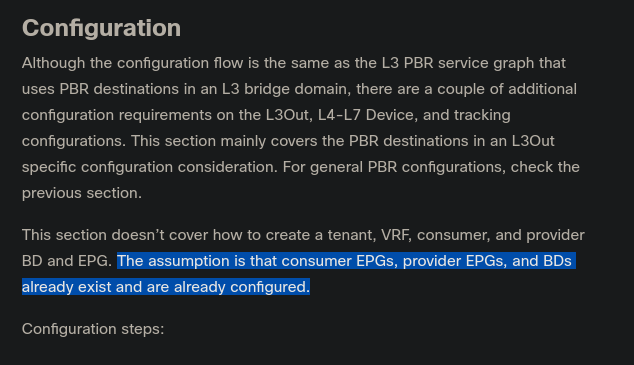 The activation condition of a Service Graph Template remains open and can only be clarified with these questions:
- Is it simply required to create the objects like VRFs, BDs and EPGs?
- Is any attachment of endpoints to the EPGs optional?
- Should traffic be generated between endpoints of the corresponding EPGs?
- Should that traffic ever match the Contract filters? This kind of questions should have been clarified in the White Paper, because any White Paper should constitute a consolidated Return on Experience. It must help readers not only understand the context of the product and the deployment steps, but also be conscious about the existence (or not) of all deployment requirements, even if they seem trivial to the author.