Miscellaneous Operations in Linux
Table of Contents
recursive lookup#
To lookup a string or file name recursively in every file, directory and subdirectory starting at a current position, use grep -r. In the example, the command found instances of journald.conf in the file named a and in the .bash_history file:
user1@rhel10-vm2:~$ pwd
/home/user1
user1@rhel10-vm2:~$ ls -l
total 152
-rw-r--r--. 1 user1 user1   2470 Aug 21 19:40 a
-rw-r--r--. 1 user1 user1 150459 Aug 19 18:13 q
drwxr-xr-x. 2 user1 user1      6 Aug 21 19:49 test
user1@rhel10-vm2:~$
user1@rhel10-vm2:~$ grep -r journald.conf
.bash_history:ls /etc/systemd/journald.conf
.bash_history:find /etc -mindepth 1 -name "journald.conf" -type f 2>/dev/null
.bash_history:find /  -mindepth 1 -name "journald.conf" -type f 2>/dev/null
.bash_history:ls /usr/lib/systemd/journald.conf
.bash_history:cat /usr/lib/systemd/journald.conf
.bash_history:find / -mindepth 1 -name "journald.conf" -type f 2>/dev/null
.bash_history:find / -maxdepth 4 -name "journald.conf" -type f 2>/dev/null
.bash_history:cat /usr/lib/systemd/journald.conf
.bash_history:systemd-analyze cat-config systemd/journald.conf
.bash_history:cat /run/lib/systemd/journald.conf
.bash_history:cat /usr/lib/systemd/journald.conf
a:# journald.conf/usr/lib/systemd/journald.conf
a:# the /etc/systemd/journald.conf.d/ directory. The latter is generally
a:# Use 'systemd-analyze cat-config systemd/journald.conf' to display the full config.
a:# See journald.conf(5) for details.
user1@rhel10-vm2:~$
To return only the first occurrence of the files which contain the search string, instead of returning the lines where the string appears, use grep -l:
user1@rhel10-vm2:~$ ls -l
total 152
-rw-r--r--. 1 user1 user1   2470 Aug 21 19:40 a
-rw-r--r--. 1 user1 user1 150459 Aug 19 18:13 q
drwxr-xr-x. 2 user1 user1      6 Aug 21 19:49 test
user1@rhel10-vm2:~$
user1@rhel10-vm2:~$ grep -l journald.conf a
a
user1@rhel10-vm2:~$ grep -l journald.conf test
grep: test: Is a directory
user1@rhel10-vm2:~$
Basic vs extended regex in grep#
With basic regex expressions (short BRE), special characters must be preceeded with a backslash if they are to be interpreted as special. Otherwise, they are interpreted as regular characters. The exception to this rule is the carrot character (^). BRE mode is activated with the -e option.
Let us consider a sample file /tmp/test.log":
Wassim@linux:/tmp$ cat test.log
a+b
a plus b
aaaaaaaab
Wassim@linux:/tmp$
Example 1: grep -e and passing the special characters without a backslash:
Wassim@linux:/tmp$ grep -e 'a+b' test.log
a+b
Wassim@linux:/tmp$
Example 2: grep -e and passing special characters wit a backslash:
Wassim@linux:/tmp$ grep -e 'a\+b' test.log
aaaaaaaab
Wassim@linux:/tmp$
grep -e 'a\+b' test.log searched for patterns like ab, aab, aaaab, etc. in the /tmp/test.log file.
With extended regex expressions (short ERE), special characters are interpreted as special without the need for a backslash.
Example 3: grep -E and passing special characters. No backslash involved.
Wassim@linux:/tmp$ grep -E 'a+b' test.log
aaaaaaaab
Wassim@linux:/tmp$
getting cpu info#
user1@rhel10-vm2:~$ lscpu
Architecture:                x86_64
  CPU op-mode(s):            32-bit, 64-bit
  Address sizes:             46 bits physical, 48 bits virtual
  Byte Order:                Little Endian
CPU(s):                      2
  On-line CPU(s) list:       0,1
Vendor ID:                   GenuineIntel
  Model name:                Intel(R) Core(TM) Ultra 5 125H
    CPU family:              6
    Model:                   170
    Thread(s) per core:      1
    Core(s) per socket:      1
    Socket(s):               2
    Stepping:                4
    BogoMIPS:                5990.40
    Flags:                   fpu vme de pse tsc msr pae mce cx8 apic sep mtrr pge mca cmov pat
                              pse36 clflush mmx fxsr sse sse2 ss syscall nx pdpe1gb rdtscp lm
                             constant_tsc rep_good nopl xtopology cpuid tsc_known_freq pni pcl
                             mulqdq vmx ssse3 fma cx16 pcid sse4_1 sse4_2 x2apic movbe popcnt
                             tsc_deadline_timer aes xsave avx f16c rdrand hypervisor lahf_lm a
                             bm 3dnowprefetch cpuid_fault ssbd ibrs ibpb stibp ibrs_enhanced t
                             pr_shadow flexpriority ept vpid ept_ad fsgsbase tsc_adjust bmi1 a
                             vx2 smep bmi2 erms invpcid rdseed adx smap clflushopt clwb sha_ni
                              xsaveopt xsavec xgetbv1 xsaves avx_vnni arat vnmi umip pku ospke
                              waitpkg gfni vaes vpclmulqdq rdpid bus_lock_detect movdiri movdi
                             r64b fsrm md_clear serialize flush_l1d arch_capabilities
Virtualization features:
  Virtualization:            VT-x
  Hypervisor vendor:         KVM
  Virtualization type:       full
Caches (sum of all):
  L1d:                       64 KiB (2 instances)
  L1i:                       64 KiB (2 instances)
  L2:                        8 MiB (2 instances)
  L3:                        32 MiB (2 instances)
NUMA:
  NUMA node(s):              1
  NUMA node0 CPU(s):         0,1
Vulnerabilities:
  Gather data sampling:      Not affected
  Indirect target selection: Not affected
  Itlb multihit:             Not affected
  L1tf:                      Not affected
  Mds:                       Not affected
  Meltdown:                  Not affected
  Mmio stale data:           Not affected
  Reg file data sampling:    Not affected
  Retbleed:                  Not affected
  Spec rstack overflow:      Not affected
  Spec store bypass:         Mitigation; Speculative Store Bypass disabled via prctl
  Spectre v1:                Mitigation; usercopy/swapgs barriers and __user pointer sanitizat
                             ion
  Spectre v2:                Mitigation; Enhanced / Automatic IBRS; IBPB conditional; PBRSB-eI
                             BRS Not affected; BHI BHI_DIS_S
  Srbds:                     Not affected
  Tsx async abort:           Not affected
user1@rhel10-vm2:~$
user1@rhel10-vm2:~$ cat /proc/cpuinfo
processor	: 0
vendor_id	: GenuineIntel
cpu family	: 6
model		: 170
model name	: Intel(R) Core(TM) Ultra 5 125H
stepping	: 4
microcode	: 0x28
cpu MHz		: 2995.200
cache size	: 16384 KB
physical id	: 0
siblings	: 1
core id		: 0
cpu cores	: 1
apicid		: 0
initial apicid	: 0
fpu		: yes
fpu_exception	: yes
cpuid level	: 35
wp		: yes
flags		: fpu vme de pse tsc msr pae mce cx8 apic sep mtrr pge mca cmov pat pse36 clflush mmx fxsr sse sse2 ss syscall nx pdpe1gb rdtscp lm constant_tsc rep_good nopl xtopology cpuid tsc_known_freq pni pclmulqdq vmx ssse3 fma cx16 pcid sse4_1 sse4_2 x2apic movbe popcnt tsc_deadline_timer aes xsave avx f16c rdrand hypervisor lahf_lm abm 3dnowprefetch cpuid_fault ssbd ibrs ibpb stibp ibrs_enhanced tpr_shadow flexpriority ept vpid ept_ad fsgsbase tsc_adjust bmi1 avx2 smep bmi2 erms invpcid rdseed adx smap clflushopt clwb sha_ni xsaveopt xsavec xgetbv1 xsaves avx_vnni arat vnmi umip pku ospke waitpkg gfni vaes vpclmulqdq rdpid bus_lock_detect movdiri movdir64b fsrm md_clear serialize flush_l1d arch_capabilities
vmx flags	: vnmi preemption_timer posted_intr invvpid ept_x_only ept_ad ept_1gb flexpriority apicv tsc_offset vtpr mtf vapic ept vpid unrestricted_guest vapic_reg vid shadow_vmcs pml tsc_scaling usr_wait_pause
bugs		: spectre_v1 spectre_v2 spec_store_bypass swapgs bhi ibpb_no_ret spectre_v2_user
bogomips	: 5990.40
clflush size	: 64
cache_alignment	: 64
address sizes	: 46 bits physical, 48 bits virtual
power management:

processor	: 1
vendor_id	: GenuineIntel
cpu family	: 6
model		: 170
model name	: Intel(R) Core(TM) Ultra 5 125H
stepping	: 4
microcode	: 0x28
cpu MHz		: 2995.200
cache size	: 16384 KB
physical id	: 1
siblings	: 1
core id		: 0
cpu cores	: 1
apicid		: 1
initial apicid	: 1
fpu		: yes
fpu_exception	: yes
cpuid level	: 35
wp		: yes
flags		: fpu vme de pse tsc msr pae mce cx8 apic sep mtrr pge mca cmov pat pse36 clflush mmx fxsr sse sse2 ss syscall nx pdpe1gb rdtscp lm constant_tsc rep_good nopl xtopology cpuid tsc_known_freq pni pclmulqdq vmx ssse3 fma cx16 pcid sse4_1 sse4_2 x2apic movbe popcnt tsc_deadline_timer aes xsave avx f16c rdrand hypervisor lahf_lm abm 3dnowprefetch cpuid_fault ssbd ibrs ibpb stibp ibrs_enhanced tpr_shadow flexpriority ept vpid ept_ad fsgsbase tsc_adjust bmi1 avx2 smep bmi2 erms invpcid rdseed adx smap clflushopt clwb sha_ni xsaveopt xsavec xgetbv1 xsaves avx_vnni arat vnmi umip pku ospke waitpkg gfni vaes vpclmulqdq rdpid bus_lock_detect movdiri movdir64b fsrm md_clear serialize flush_l1d arch_capabilities
vmx flags	: vnmi preemption_timer posted_intr invvpid ept_x_only ept_ad ept_1gb flexpriority apicv tsc_offset vtpr mtf vapic ept vpid unrestricted_guest vapic_reg vid shadow_vmcs pml tsc_scaling usr_wait_pause
bugs		: spectre_v1 spectre_v2 spec_store_bypass swapgs bhi ibpb_no_ret spectre_v2_user
bogomips	: 5990.40
clflush size	: 64
cache_alignment	: 64
address sizes	: 46 bits physical, 48 bits virtual
power management:

user1@rhel10-vm2:~$
Linux networking#
Display IPv4 addresses in oneline:
user1@rhel10-vm2:~$ ip -4 -o address show
1: lo    inet 127.0.0.1/8 scope host lo\       valid_lft forever preferred_lft forever
2: enp8s0    inet 192.168.122.6/24 brd 192.168.122.255 scope global dynamic noprefixroute enp8s0\       valid_lft 2789sec preferred_lft 2789sec
user1@rhel10-vm2:~$
user1@rhel10-vm2:~$
Another example:
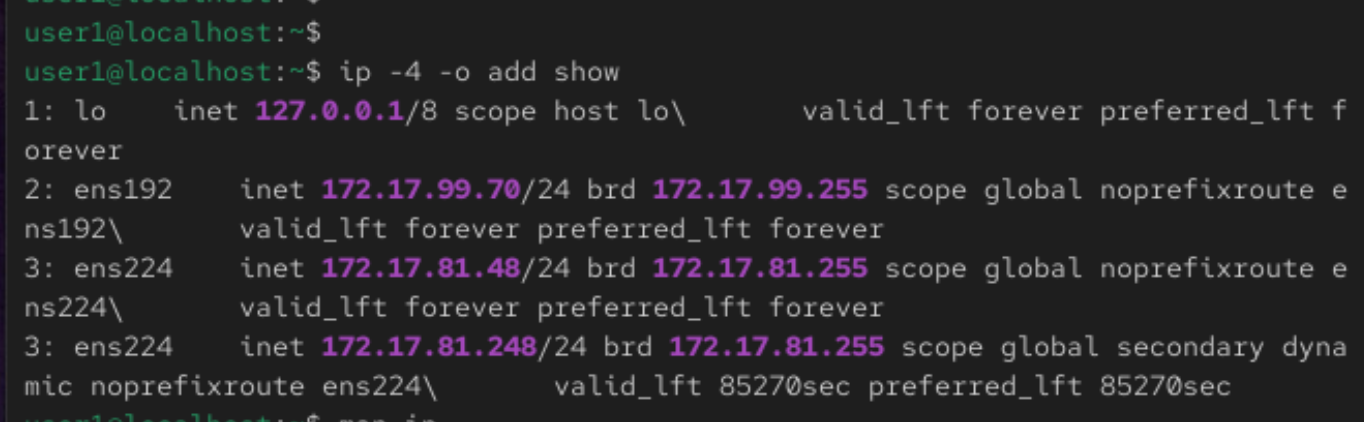
Interface ’ens224’ has two IP addresses, one of which is secondary.
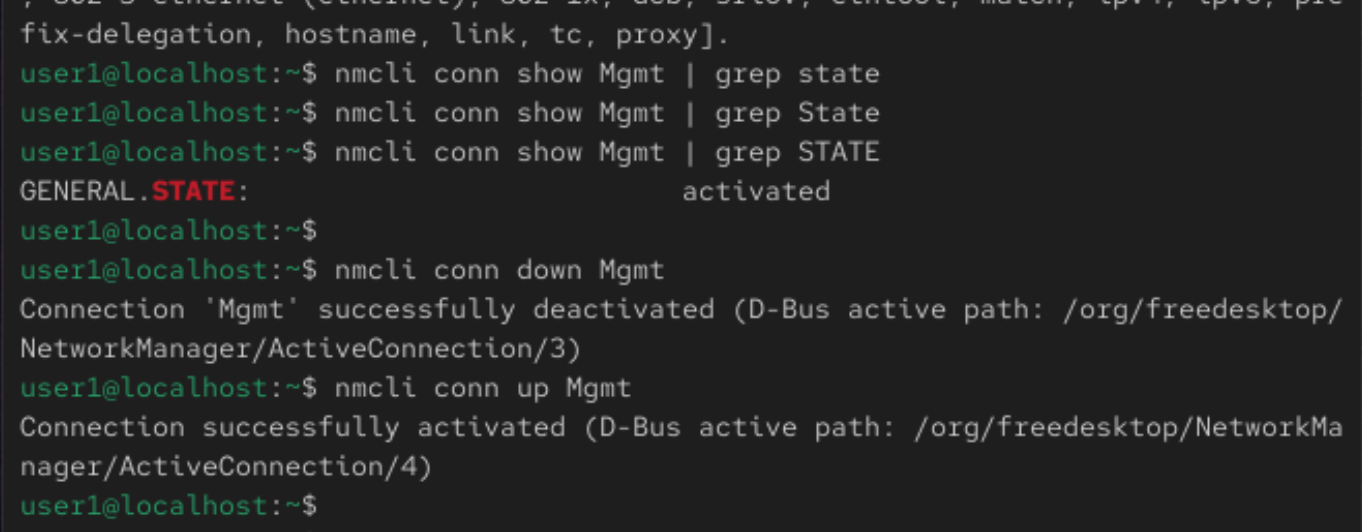
To delete the secondary IP address, start by removing it using nmcli connection modify:

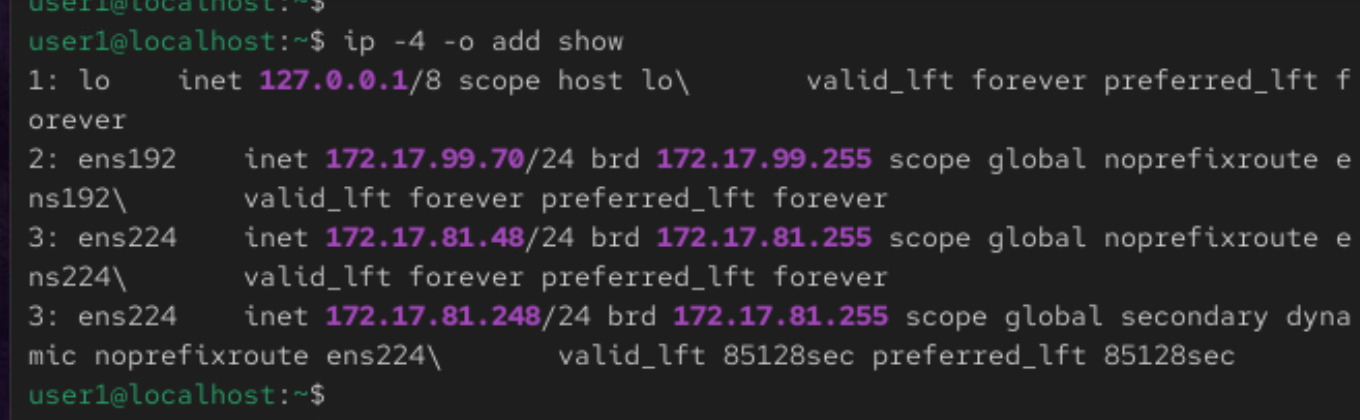
But removing the secondary IPv4 address with nmcli alone does not clear it from the assigned IP addresses to the interface:
Bouncing the network connection:
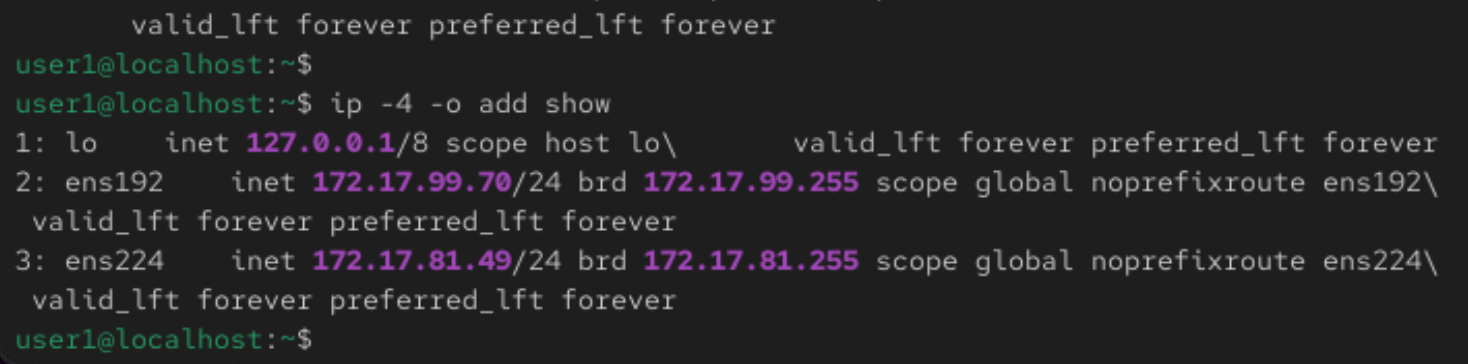
Verifying the IPv4 addresses assigned to the network interface demonstrates that an interface bounce is mandatory to refresh the number of assigned IP addresses:
disk usage#
To display the disk usage of each directory of a directory passed in the argument recursively, and a total usage in the last line of the output:
Wassim@linux:~$ ls -l Videos/
total 0
drwxr-xr-x. 2 Wassim Wassim 26 Apr  7 12:42 Camera
drwxr-xr-x. 2 Wassim Wassim 54 Mar  5  2026 Screencasts
Wassim@linux:~$
Wassim@linux:~$ du Videos
45760	Videos/Camera
3180	Videos/Screencasts
48940	Videos
Wassim@linux:~$
In a human-readable format, i.e. using KiB, MiB and GiB:
Wassim@linux:~$ du -h Videos
45M	Videos/Camera
3.2M	Videos/Screencasts
48M	Videos
Wassim@linux:~$
To display only one line summary of the disk usage of the directory passed in the argument:
Wassim@linux:~$ du -s Videos
48940	Videos
Wassim@linux:~$
Wassim@linux:~$ du -sh Videos
48M	Videos
Wassim@linux:~$
To recursively display directory and file disk usage of the directory passed in the argument:
 du -ha Videos
45M	Videos/Camera/MOV00000.AVI
45M	Videos/Camera
3.2M	Videos/Screencasts/Screencast From 2026-03-05 14-35-36.webm
3.2M	Videos/Screencasts
48M	Videos
Wassim@linux:~$
Adding time of last modification:
Wassim@linux:~$ du -ha --time Videos
45M	2024-03-09 03:26	Videos/Camera/MOV00000.AVI
45M	2026-04-07 12:42	Videos/Camera
3.2M	2026-03-05 14:37	Videos/Screencasts/Screencast From 2026-03-05 14-35-36.webm
3.2M	2026-03-05 14:37	Videos/Screencasts
48M	2026-04-07 12:42	Videos
Wassim@linux:~$
To add a cumulative line of total disk usage of the directory passed in argument:
Wassim@linux:~$ du -hc Videos
45M	Videos/Camera
3.2M	Videos/Screencasts
48M	Videos
48M	total
Wassim@linux:~$
mount and umount of external storage disks#
Disk inserted. Then:
Wassim@linux:~$ dmesg | grep sd
dmesg: read kernel buffer failed: Operation not permitted
Wassim@linux:~$
Wassim@linux:~$ sudo dmesg | grep sd
[sudo] password for Wassim:
[    1.860365] ahci 0000:00:17.0: flags: 64bit ncq sntf pm clo only pio slum part deso sadm sds
[ 2879.451415] sd 2:0:0:0: [sda] Spinning up disk...
[ 2879.483095] sd 2:0:0:0: Attached scsi generic sg0 type 0
[ 2882.551227] sd 2:0:0:0: [sda] 1953525168 512-byte logical blocks: (1.00 TB/932 GiB)
[ 2882.552147] sd 2:0:0:0: [sda] Write Protect is off
[ 2882.552151] sd 2:0:0:0: [sda] Mode Sense: 43 00 00 00
[ 2882.552567] sd 2:0:0:0: [sda] Write cache: enabled, read cache: enabled, doesn't support DPO or FUA
[ 2882.642396]  sda: sda1 sda2 < sda5 sda6 >
[ 2882.643274] sd 2:0:0:0: [sda] Attached SCSI disk
[ 2884.743386] FAT-fs (sda5): Volume was not properly unmounted. Some data may be corrupt. Please run fsck.
[ 2884.829641] FAT-fs (sda1): Volume was not properly unmounted. Some data may be corrupt. Please run fsck.
Wassim@linux:~$
I look for /dev/sda virtual block device:
Wassim@linux:~$ lsblk
NAME        MAJ:MIN RM   SIZE RO TYPE MOUNTPOINTS
sda           8:0    0 931.5G  0 disk
├─sda1        8:1    0 612.6G  0 part /run/media/Wassim/BLACK 3
├─sda2        8:2    0     1K  0 part
├─sda5        8:5    0 161.5G  0 part /run/media/Wassim/BLACK 1
└─sda6        8:6    0 157.5G  0 part /run/media/Wassim/Black 2

<---- output omitted ---->