Posts for: #Service_insertion

ACI Multi-Pod and Active-Standby Firewall in Routed Mode

Stretched Active/Standby Firewall

I must define an ACI L4-7 Device with two Concrete Devices; One for the Active node and one for the Standby node. See ACI Multi-Pod and Service Node Integration, page=5. The active firewall is in pod A, the standby firewall is in pod B. Support east-west and north-south traffic flows. No risk of asymmetric traffic flows because there is only one active firewall at a time.

Impact of traffic hair-pinning

Hair-pinning is a sub-optimal yet not avoidable traffic pattern. Beware of the latency impact of any hair-pinning traffic between pods due to traffic traversing the active firewall. The worst-case occurs when:
[Read]

Cisco ACI L4-7 Service Insertion: Standard Service Graphs with Firewall in Go-To Mode

#QA SSG with L4-7 Device in Go-To mode: in which situations do we need only layer-2 BDs attached to the Device? Layer-3 BDs? one Layer-2 and one Layer-3 BD? what is the recommended design? Go-To mode == Routed mode When NAT needed on the L4-7 Device: use Service Graph in Go-To mode with NAT. another ‘sub-mode’ is an L3Out between the L4-7 Device and ACI. With both NAT sub-mode and L3Out sub-mode:

[Read]

Inserting firewall packet inspection services in Cisco ACI data paths without offloading the gateway service off the fabric

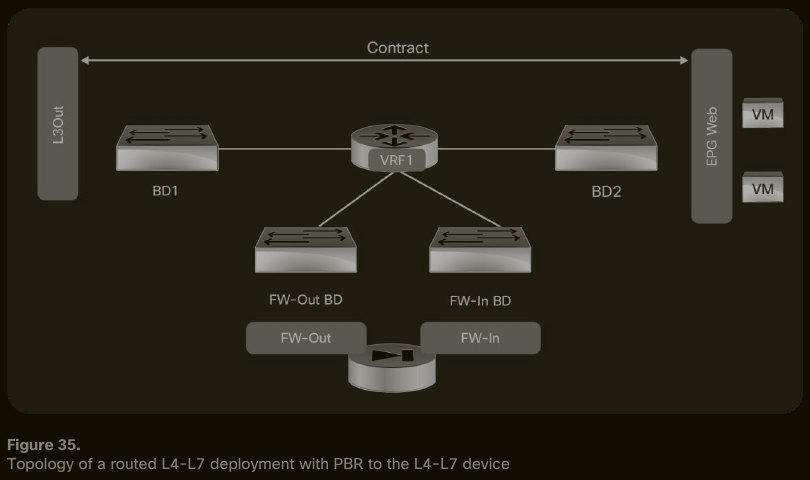
PBR in two-arm design, the PBR Node Interfaces are in the same VRF

sc1

#QA In the SGR in Go-To in Two-arm design, how does IP routing on the firewall scale when we have dozens of (Provider, Consumer) pairs? #QA How cumbersome is the management of the static IP routes related to the SGR on the service device? #QA Is BD2 the IP default gateway for EPG Web endpoints? #QA Which component takes the role of IP default gateway of the firewall: BD1 or FW-Out BD?

[Read]