Posts for: #In_progress

Operations with git

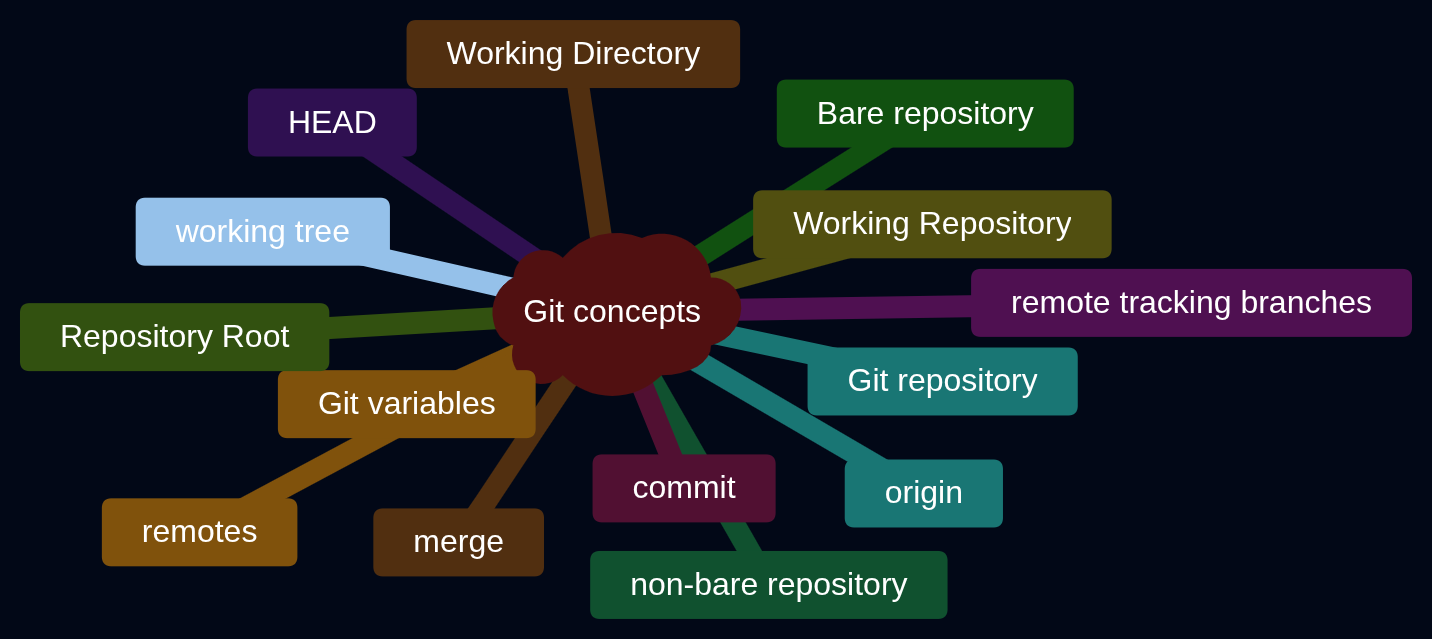
gitterminology.png

Git vs SVC

An SVC is a type of Software Configuration Management (SCM) git is the most popular distributed software version control (dsvc)

Git vs Github

Git is the DSVC (Distributed Software Version Control). Github is a cloud platform that uses Git as its core technology plus additional features like Discussions and Pull Requests.

Using Git

There are CLI tools like Git Desktop and GUI tools like Microsoft Visual Studio Code to use Git. GUI tools have their own limitations.
[Read]

ACI L4-7 Service Insertion_Failover Traffic Management

Failover traffic is not managed by L4-7 Service Graphs

See the document ACI Service Graph Design Guide for ACI 5.2 and Later.pdf, page=50.

With the ‘out-of-band’ method

Use the dedicated firewall failover link ports and firewall stateful failover link ports, or designate some ports for that role; Failover traffic and stateful failover traffic are said to be managed ‘out-of-band’

With the ‘in-band’ method

i.e. use the physical network of the data traffic for failover and stateful failover traffic too. When the firewall is attached to ACI, the physical network path of firewall traffic is the ACI fabric.

[Read]

VMware vSphere Networking Concepts

In VMware, a good practice is to configure ESXi hosts in a cluster, then present the LUNs to the ESXi cluster. A VMware datastore is a LUN that has been formatted with a filesystem like VMFS. A VMware VM can access the datastore but has no awareness of the underlying LUN or its constituing storage disks. Any protocol that carries the SCSI Command descriptor Block (like FC, FCoE, iSCSI, SAS) uses the LUN concept. A successor to SCSI is NVMe. When I configure a new datastore in a vCenter datacenter, I am presented by a menu to choose a ESXi from. (sc) This is because vCenter simply does not have direct access to the storage devices; it asks that selected ESXi server (can be seen as a ’temporary agent’) to access the storage devices ot its behalf, format the access storage as VMFS disks and make them available in the datastore to many ESXi hosts. This action is only required once during the configuration of the datastore. This interaction takes place on the management vmkernel of the ESXi host. Later when I attach the datastore to the ESXI hosts, they will be able to access the VMFS disks directly, and they will access the storage devices.

[Read]

NSX-T Concepts

VMware NSX-T does not support VXLAN!

NSX-T Segments

a VM is connected to a segment.

  • is a layer-2 domain.
  • invokes a transport zone.
  • once the transport zone configured, you can no longer edit it later.
  • VLAN-based segments are equivalent to VLAN IDs
  • VLAN-based segments are not permitted to connect to Tier-0 or Tier-1 gateways.

require VLAN transport zones. A single Edge Uplink segment can be used more than once.

[Read]

NX-OS boot sequence stuck in loader prompt

Path in Cisco Documentation

cisco.com/go/support –> Switches –> Nexus 9000 –> Troubleshooting Guides –> (select NX-OS release) –> “Cisco Nexus 9000 Series NX-OS Troubleshooting Guide, Release …” –> Troubleshooting Installations, Upgrades and Reboots –> Chapter Contents –> Troubleshooting Software System Reboots –> Recovery from the loader> Prompt.

Assumption 1: NX-OS File in Bootflash

Loader> dir
<you see for example nxos.9.3.13.bin NX-OS file in the bootflash>
Loader> boot nxos.9.3.13.bin

The system should boot the image. When you get the normal prompt, make sure to set the bootvariable to that NX-OS image:

[Read]

Operations with Python

preparing the work environment

First, I have the habit of working in virtual environments. I create one and activate it:

Wassim@linux:~/private/labscripts$ python -m venv venv
Wassim@linux:~/private/labscripts$ ls
venv
Wassim@linux:~/private/labscripts$ source venv/bin/activate
((venv) ) Wassim@linux:~/private/labscripts$

I initially wanted to install a virtual environment for Linux and another one for Windows in the same directory. It looks like the installer failed me silently. No exe or bat files were installed. So, I deleted the venv directory that I created weeks ago on my Linux machine using rmdir /S, and recreated it on Windows with python -m venv .\venv.

[Read]

SSH

SSH on Cisco devices

SSH Terminal-Line Access Feature

replaces reverse Telnet feature that was typically configured on terminal services routers.

provides secure console access for servers physically connected to a terminal services router.

introduces the concept of ‘rotary’.

Remember that each physical Async port has an associated logical line to it.

Each router line (not the Async ports) must be configured with a unique rotary number.

Number of rotaries == number of lines

[Read]

Basic MPLS L3 VPN Concepts

VPN Advantage

A VPN is a network where private network services are provided to one or more customers over a public network, Internet, or a private network. 

A VPN consists of one or more VPN tunnels! 

VPN connects sites of a same customer together.  A set of “policies” determine which sites communicate with each other and which not;  

In one scenario, the customer itself defines and implements them, in collaboration with the SP. The customer may for example want to force traffic from site S1 to traverse site S2, because the latter has a firewall installation. 

[Read]

Cisco Auto Qos Configuration

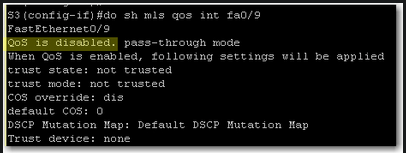
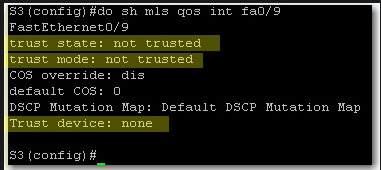
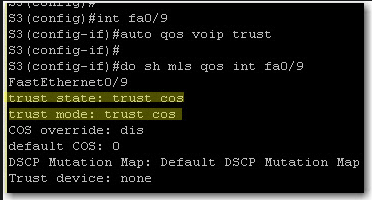
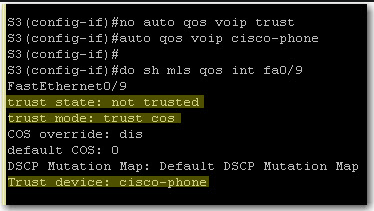
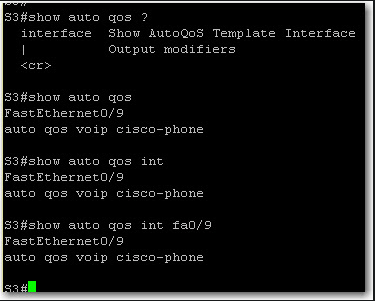
First, let’s see if QoS is enabled on the switch: autoqos01 QoS is disabled. We should enable it on global configuration level: autoqos02 If we want to display QoS settings for an interface, we do a show mls qos interface command: autoqos03 At this stage we still did not define trust boundaries. That’s why Trust State and Trust Mode say “not trusted”. And we did not specify whether we’ll trust a device or not. To define trust boundary with auto-qos, we either trust all CoS values coming on the switch interface or we trust CoS values only if an ip phone is connected to the switch port. With auto qos voip trust, we tell the switch to trust CoS on each packet coming on the switch interface: autoqos04 If we want to further limit trust boundary, we can tell the switch to trust CoS values only if a Cisco ip phone is detected on the port: autoqos05 Finally, on a 3550 switch, show auto qos and show auto qos interface give the same output: autoqos06

[Read]

Loop Guard on Cisco IOS

Enabling Loop Guard on an interface level does not enable it for the whole system. In fact, a “show spanning-tree summary total” is a bit misleading in this case.

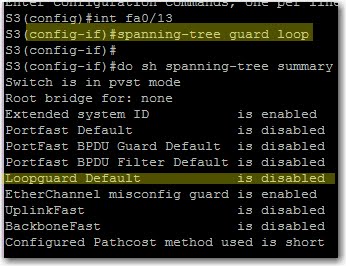
To configure loop guard on an interface: sc1

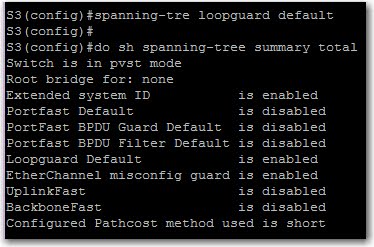
“loop guard default” is disabled because we haven’t issued a “spanning-tree loopguard default”. Easy: sc2

[Read]